
For much of our China holiday it rained. Heavily. The Li River was a swollen, swirling, brown mass, angrily rushing past our Guilin hotel. It had already broken into the park on the opposite bank, and I was anxiously watching the water level creep up the galloping horse statues, as the the next leg of the journey was on the river.

But this day, we were visiting the Longji Rice Terraces, a place on the itinerary that I had particularly looked forward to. I love rice fields; they rate very highly in my scenic preferences. I still clearly remember my first trip to Bali, back in the seventies. Scooting around the island on a motorbike and rounding a corner, there, laid out before us, was my ;first sight of a beautiful curving hillside of rice terraces; brilliant green, with water sparkling silver in the late afternoon sun. It was love at first sight and I have never forgotten it.
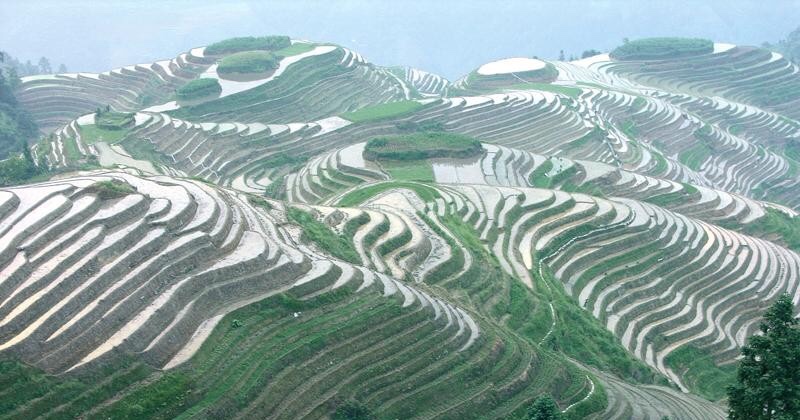
Construction of the Longji Rice Terraces began in the early 1200’s by the Zhuang people, who had lived in the area since ancient times, and mainly completed by the mid 1600’s. Covering an area of 66 square kilometres, the terraces are a tribute to the engineering skills and hard labour of the Zhuang, as they still function in their original form today. For the past several hundred years the fields have been tended by both the Zhuang and Yao ethnic minority groups, and all work is still done by hand.

The lines of the terraces marching up and down entire mountains and valleys create a visual spectacle of awesome beauty. Longji translates as “Dragons Back”, and this is clearly illustrated by the zig-zag effect as you run your eye along the profile of a mountain ridge. The water reflections from the flooded channels recreate the scales upon the dragons back.
We hired a driver for the almost 2 hour trip, and after passing through low-lying karst countryside then crossing a range, we finally pulled off the side of the road at the base of a rough mountain track. Very few people spoke English at that time and our driver was no exception. He grunted and pointed to the track, indicating by gestures that he would be asleep in the car when we returned, and slid down into slumber position.
We got out, put on our raincoats and got our bearings. We were in a shallow open gorge at the confluence between two small rivers, and could only see scrubby forested slopes on either side. There was not a soul, or a sign, in sight. We knew we had about an hour’s walk up the mountain so started onwards and upwards the muddy track. Happily, the rain had eased a little.

About two thirds of the way up, we rounded a corner and came across a small group of Yao. Easily recognizable by their colourful traditional clothing amongst the nondescript garb of the rural Chinese, we had previously seen them walking the Guilin streets and operating stalls in the markets. There they sell the embroidered handicrafts and silverware for which they are renowned. I should imagine I even bought some! It is always a treat to see people wearing their traditional costumes in their general daily life.

The Yao are one of the ancient ethnic minority groups that are scattered over the southern areas of China and the northern areas of Vietnam, Thailand, Laos and Myanmar. They still hold most of their culture and traditions pure to this day. Preferring to live in mountainous areas, they are hard-working and live mainly off the land. Their belief system is a nice potpourri of Animism and Ancestor Worship, with splatterings of Taoism, Buddhism, Christianity and even sometimes Wizardry. Their religious practitioners are shamans, whose main focus is the protection and expulsion of troublesome ghosts and evil spirits. They speak their own language, orally passed down through the generations. Legend tells that in a past great famine, all their writings were destroyed when books were boiled and eaten by the starving people, thus rendering the written work undependable. They are a colourful lot, both visually and in culture.
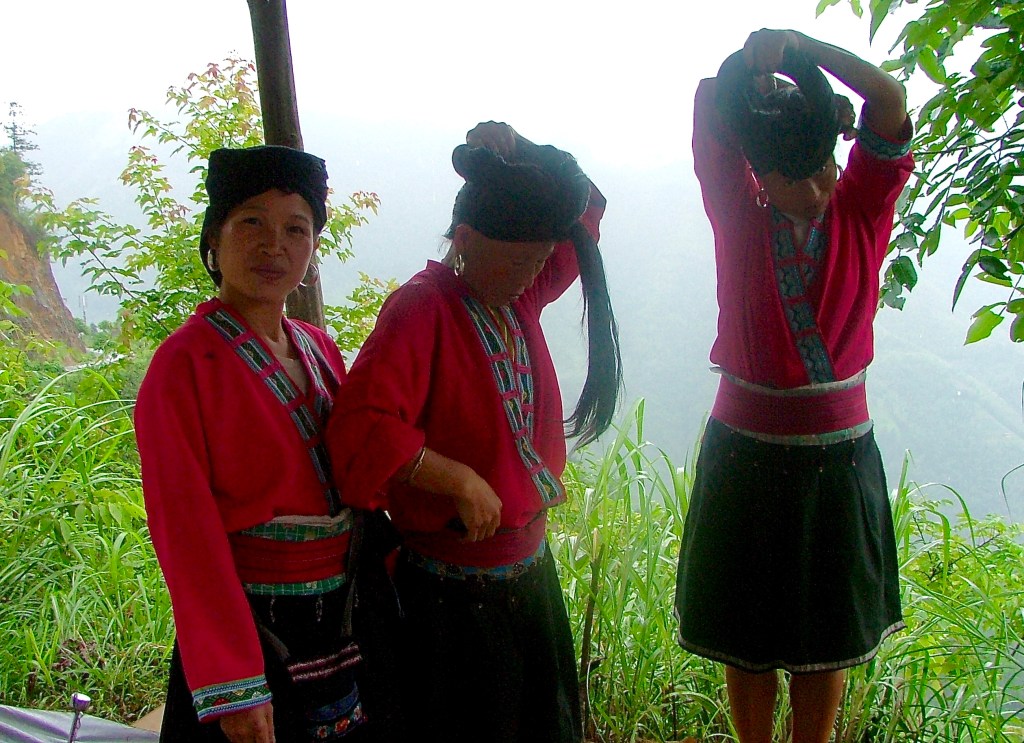
One of the notable things about traveling in China with children, was the amount of attention they received, especially away from Beijing and Shanghai. It broke down language barriers and also cultivated conversation pieces. It was no exception here, and as we approached, the girls swarmed excitably around our girls. So we embarked on the pantomime of smiling, nodding and hand waving, peculiar to encounters between people with no mutual language, and a form of communications was struck up.

The Yao are also referred to as the “long-haired people” because of the custom of only cutting their hair once in their life, the day of their eighteenth birthday. Now, this custom is mainly adhered to by the women although some men still abide by it as well. Most women have hair between one and two metres long, wearing it wound around their head in an ever-widening bun. And there is not just one layer of hair, but three: the first layer their natural hair, the second being the hank that was cut off at eighteen, and the third being the hair that is collected from their daily hair-brushing ritual. The girls in this group were relatively young, but proudly unpinned their hair and dropped it forward for us to admire. Photos were taken, and having exhausted our limited communicating skills about as far as we could, we took our leave in a flurry of smiles and waves.

We could now see the village further up the mountain. Flanked by the rice terraces, the all-wooden houses were built into the steep slopes and appeared as if they were stacked on top of each other. Upon finally reaching the base of the village, the path narrowed to single file, and as we passed the lower levels of the houses, we encountered the usual oxen, pigs, dogs, poultry, ducks and geese foraging around. Yao houses are traditionally built on stilts, the under-story houses the family animals and agricultural implements, the upper level for family living. Family areas were open and spacious, many with large windows and glorious views. We climbed up roughshod steps and made our way into the streets, which only catered for walking traffic. Apart from the animals, there was hardly a soul in sight. An old man sat in a doorway mending tools and watched us impassively.

The village was small, probably no more than thirty or forty families. There was no sign of any shops or workplaces. Neither were there any of the shrines or pagodas we had got used to seeing, so the village probably being traditional in its religious observances. We wandered the empty streets, the only ones out and about, the ever-increasing rain and our footsteps the only sound. It was a little unnerving. You knew, could almost feel, unseen eyes watching you curiously. We came across a possible eating place. Tentatively we peeked in; it was empty, but with relief someone emerged and warmly welcomed us into the dry. Waiting for our meals, we gazed out the broad windows at the stunning panorama of terraced rice fields stretched out in front of us, up and down the mountains to the valleys below and beyond. Our food arrived and it was decision time. The idea had been to do a comprehensive hike across the mountains but the now torrential rain was certainly putting a damper on that. It was decided that my daughter and I would continue on with a shortened version of our plans, and that my husband and other daughter would sit it out in the dry. So we donned our raincoats again and ventured forth.

Back outside in the street, we found a path leading upwards so we started that way. We had just left the village when we were caught up with by a middle-aged woman, armed with a waving umbrella, who yelled and gestured furiously at us, presumably about the imprudence of being out in such weather. Standing firm against her insistence that we turn back we continued on. Of course she followed! Bowing to the inevitable, we stopped again, haggled the price we would be expected to pay at the other end, like it or not, and, after a bit more of unintelligible chattering, umbrella waving and now a smile, a deal was made and we set of yet again. To be honest she was a major nuisance, but experience told me she was not going to go away. So we just went with it, and, as is so often the case, she became firmly entrenched as a fond, (but still irritating) and integral memory of the day.

Our walk through the paddies in the pouring rain became one of the most memorable experiences in my life. The channels were now overflowing the levels and onto the paths unrestrainedly. Firmly barring from my mind thoughts of leeches and other prospective unknown foreign critters, bugs or microbes, I put caution to the wind and we took off our shoes and socks, and paddled bare-footed in the mud. Our raincoats were saturated, water streamed off our bodies, it was virtually impossible to take photos, and we could hardly hear each other speak. But for the next hour and a half we sloshed through the rice fields and it was glorious!

The rice was well-established and lush, gleaming clean and vibrant green. Water-chestnuts grew prolifically along the edges of the paths, duck families frolicked and dived in the channels and overflows, and in every direction there was the endless view of endless rice fields. It was truly exhilarating.

There are all sorts of fantastical names for these mountains and valleys: “Nine Dragons and Five Tigers”, “Seven Stars Around the Moon”, “Golden Buddha Summit” and so on. We had no way of knowing which was what, but it did not matter. Just the knowing that this beautiful place is celebrated with such magical names was enough.

Eventually it was time to circle around and return to the village. We conveyed our thanks and goodbyes to our “guide”, along with the relevant largesse, and walked back down the mountain to our trusty driver, and the long drive back to Guilin.
But there was one more footnote to the story of this day apart from hot showers and dry clothes. A loo stop. My daughter just could not wait! So, on the side of the mountain we pulled over to an extremely old, open concrete block. Chinese toilets were either very dirty, or so clean you could eat off the floors. There seemed to be no middle ground. This one was, of course, the former. Against my better judgement we entered, and, not unexpectedly, my fears were confirmed, It was eyes closed, hold your breath, pretend you are not here, disgusting! My wanderings have made me no stranger to extremely dirty and/or primitive toilets, but this one still ranks as the worst. Haha…. the joys of travel! But after all these years, the image of that atrocious loo is still as vivid as those of the fabulous rice terraces and the wonderful time I had there.
Is there some moral here? Would I hold such special memories of this day if the weather had not been so horrendous; if those terraces had been bathed in sunlight with blue skies reflecting in the water, with everything pristine and not obscured by walls of rain? Who is to say? But nothing can make me regret any of my wondrous day there, and I would return in a heartbeat to re-experience and re-explore. I do believe, however, they are now very much part of the tourist trail, so it would be very unlikely I ever have the privilege of having them all to myself again.

 truintraveltales.com