

My plan was for a morning of aimless browsing. I wanted to cut back on attractions this day, content to just soak up the atmosphere of the town, and generally have a good old people watch. It was still early, and walking the dirt track into town, I only passed a couple of kids playing at the edge of a drain, and stepped aside for a lad wobbling on his bike, over the rough track. Arriving at the street running parallel with the curve of the lake, things started to get much busier. Much more like India!
Pushkar, this most ancient of cities, sits on the south eastern edge of the Thar Desert. Inscriptions and coins date it back to the 4th century BC, but today, it is a fairly small town wrapped around the shores of a lake of the same name. It is famed for it’s annual camel and livestock fair (the largest in India), and for being the centre of a flower farming industry, exporting blooms world-wide. But most importantly, Pushkar is a sacred city, and Pushkar Lake a sacred lake; one of the five pilgrim sites in India for the followers of Hinduism. The lake has 52 ghats (stone staircase bathing platforms for ritual bathing and immersion), and over 400 blue temples line it’s shores. It is also home to the oldest, and one of only six, Brahma Temples in India.

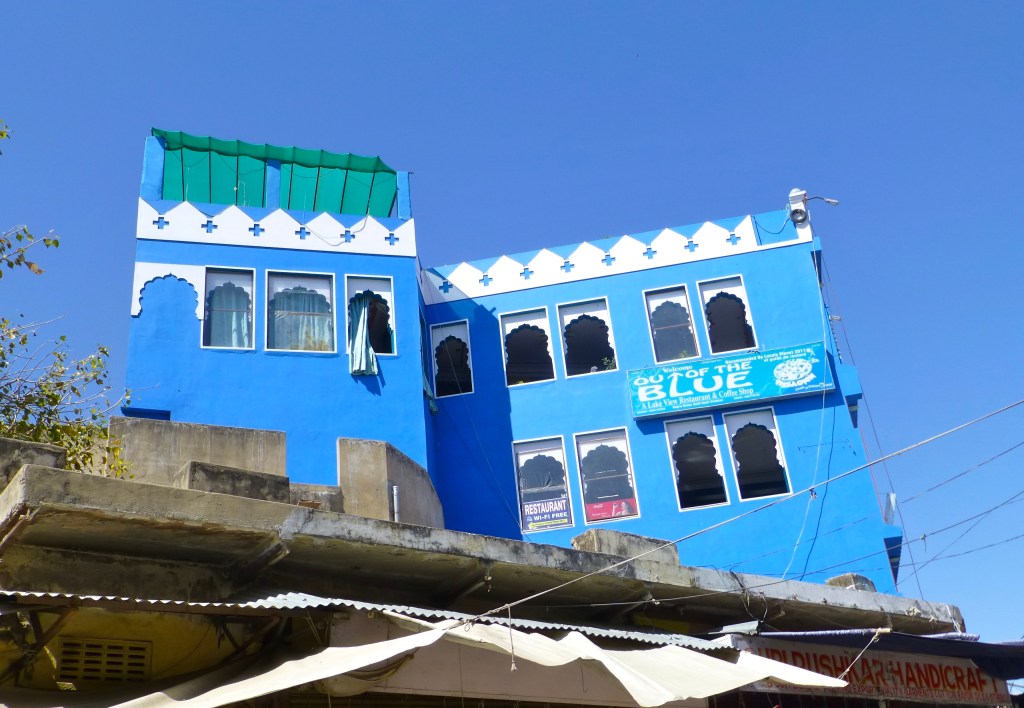


The main street was pretty typical. Most buildings were two or three storied, in single or multiple blocks, in various states of disrepair, and built with absolutely no sense of collective planning. One can only experience Indian architecture, not describe it. But the wide variations in age, style, colours, usage and damage scale, provided unending interest as I made my way along the street. In my mind, the chaotic haphazardness added to the charm.
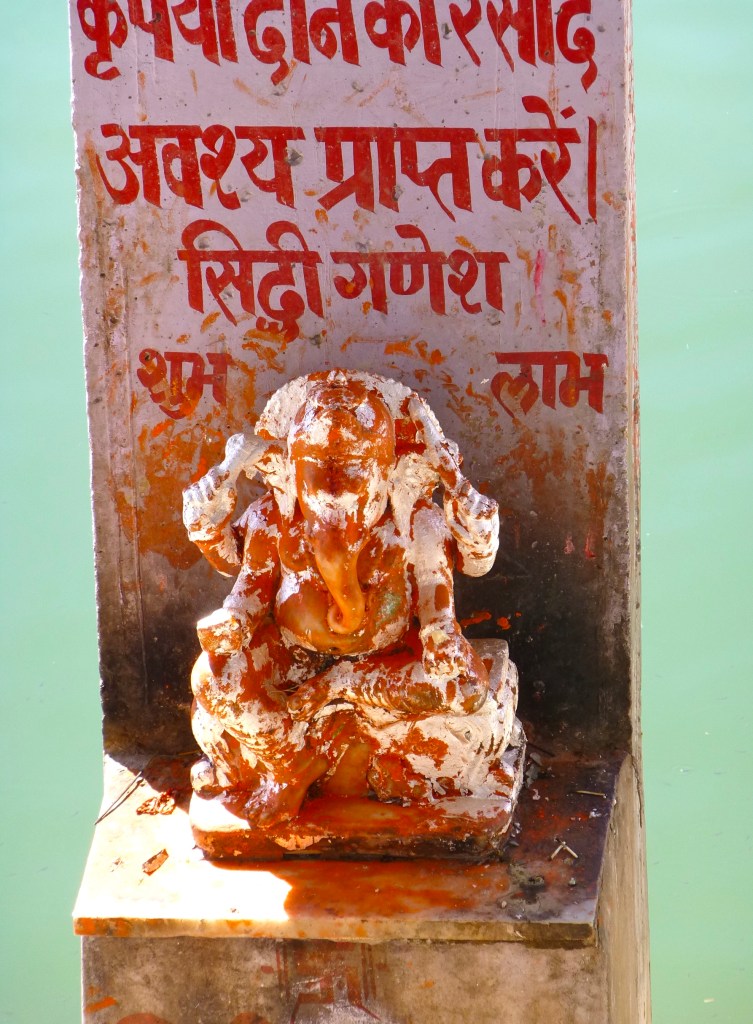
I passed by many temples, feeling a twinge of guilt for not visiting one of the few dedicated to the mighty Lord Brahma, but I remained mentally firm on my “temple-free” day. Shrines were tucked into all sorts of nooks and crannies, usually daubed with that delightful smear of bright orange paint, and many had offerings of incense and flowers at their base.

Shopkeepers sat in their doorways; all men, as is the custom anywhere in rural India and most other places as well. They passed the time of day with their neighbours, drinking chai, smoking, listening to tinny transistors or playing board games. Occasionally they would call out to me in a desultory manner, hoping to lure me in to buy, but the calls lacked insistence compared to elsewhere in India. The shops seemed to cater mainly to tourists, the odd treasure among endless junk. It was blatant commercialism without any pretense of authenticity, but the jumble, variety and colour all added to the flavour of the street. There were only a few street hawkers about, and even they were not overly persistent, which was astounding, as I had found them to be India’s biggest headache.
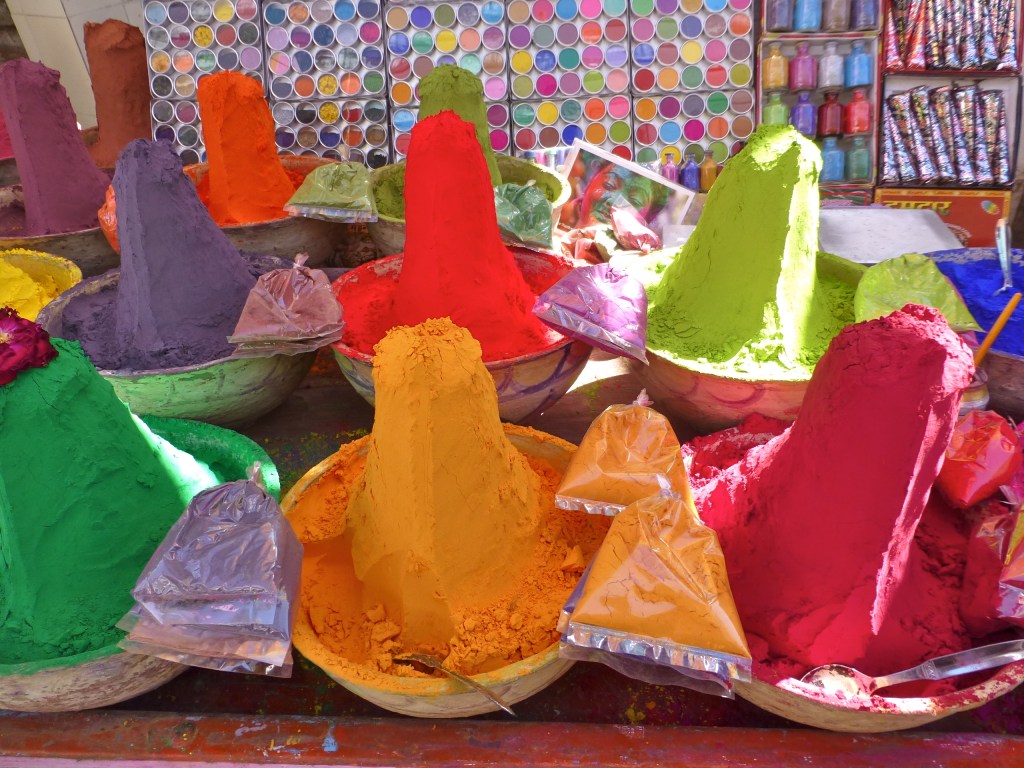
Food shops emanated tantalising aromas from their open kitchens. Big vats of curries bubbled merrily, trays of samosas prepared and ready to cook, and chapatis stacked in high piles. There was the musky smell of incense burning at shop doorways, temple entrances and shrines. Open sacks of fragrant herbs and spices wafted out pungent smells, and cones of henna and water-colour powders created stunning visual contrasts.
Tinkling music, drum beats, bells and rhythmic chanting floated out of doors and windows. The hammering and crashing of tradesmen intruded. A very loud generator was running an equally loud hand cement mixer. Scooter horns beeped incessantly (although this was an act of notification, not annoyance or impatience). Well mainly!
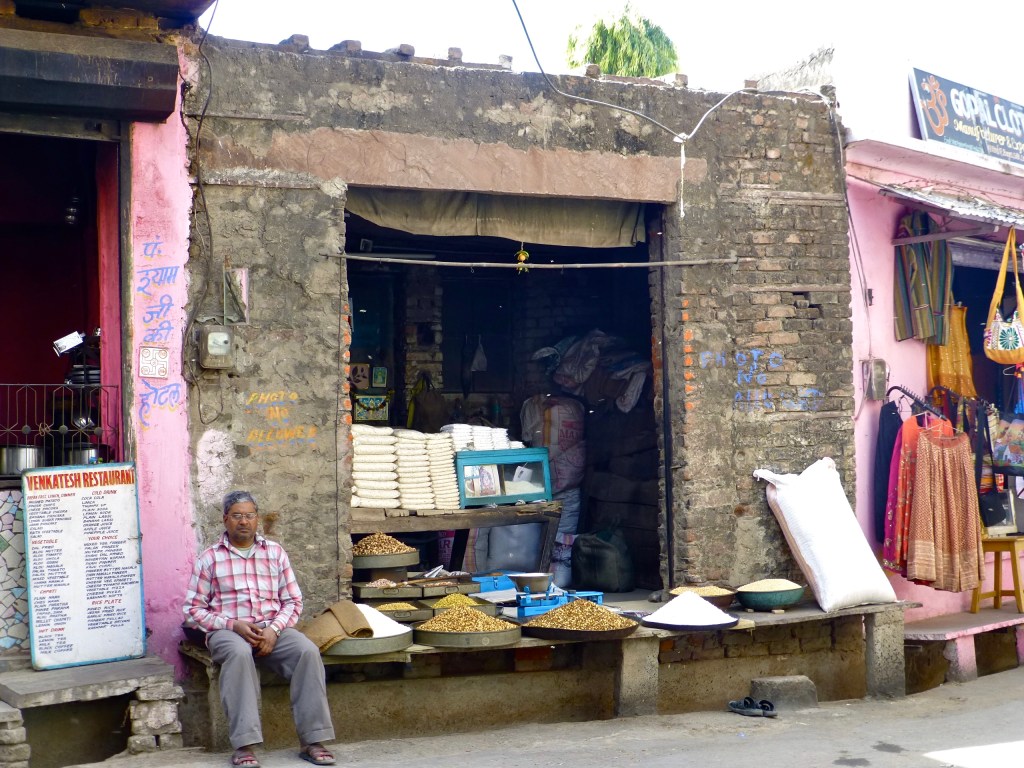
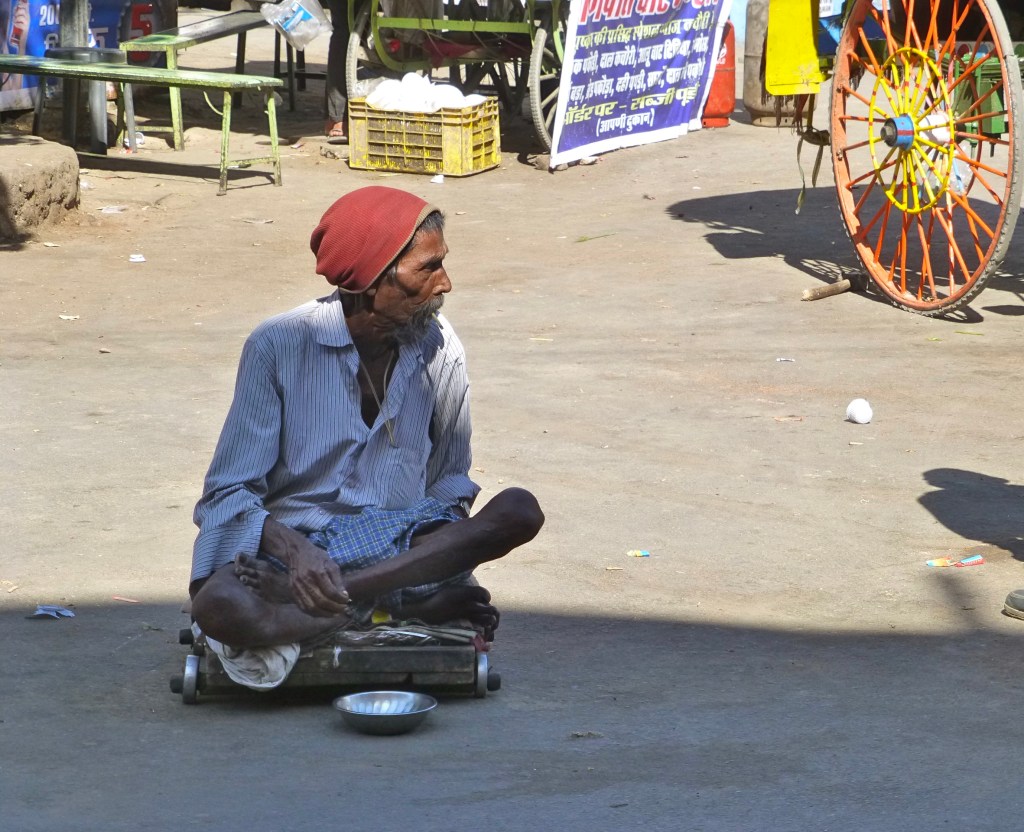

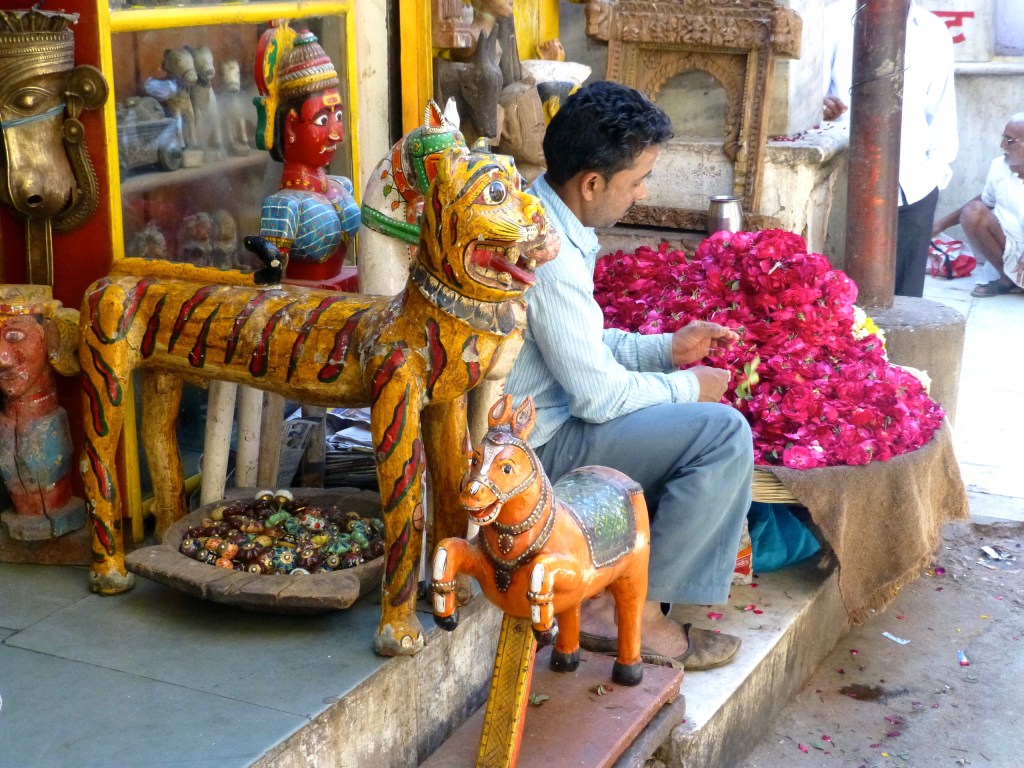


Holy men sat cross-legged on the ground wherever it suited them, regardless of traffic, or any other apparent observances. Motionless, with downcast eyes and expressionless faces, they were islands of stillness. Beggars crouched with outstretched arms and plaintive voices, beseeching alms. Businessmen stood in groups, deep in grave discussions. Boys with juice machines attached to their bicycles, and loaded high with sugar cane stalks, were strategically positioned to waylay the thirsty. Tradesmen and donkeys laboured under their loads, or focused on their jobs. Some backpackers emerged, probably looking for food. Women in their beautiful and brightly-coloured saris, clustered in doorways happily chattering with friends and neighbours. Other women (probably from a lower caste), sat on the ground selling produce and garlands.

I loved these garlands, marveling at the patience and skill of the women and girls creating them, in incredible amounts. Intended as daily offerings to the gods, they seemed invariably made of marigolds and gardenias. They were heavy, and so soft, the tightly woven blooms misted with water to keep them fresh, and they filled the air with sweet perfume. I bought one, slung it around my neck, and relishing the feeling of the cool dampness, wandered on.
Everything overlapped. There were no footpaths, and traffic, cows, horses, carts, dogs and people, either stood, sat, slept, or weaved randomly along the street, all with intent, but without any sense of priority over the other. India is an assault on the senses, and Pushkar was doing it proud. But I picked up on an added feeling of mysticism here, and a much more relaxed energy, reminding me just a little of the hippie towns at home.
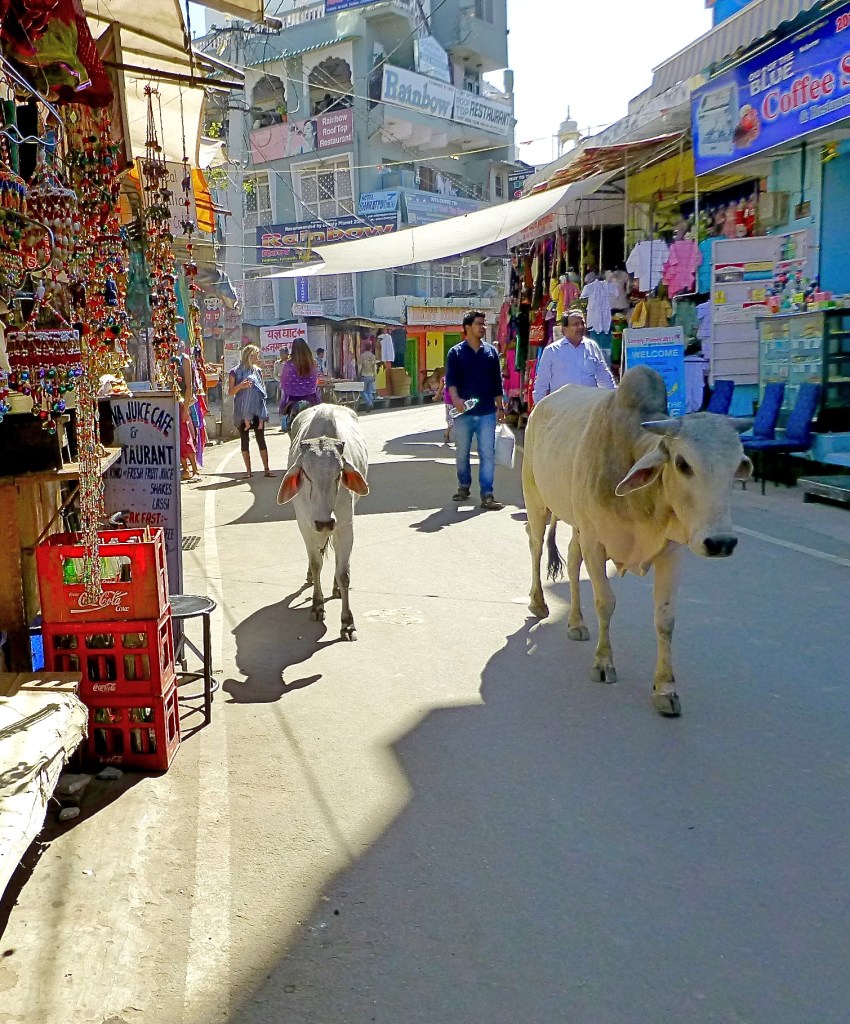
I love the cows of India. Some were just wandering aimlessly, like myself, but others had found a spot to lay in the sun, contentedly chewing their cuds. They are a constant presence of calmness in the chaos around them, in spite of the fact they create much of it. Their movements are slow and measured, as if they have all the time in the world, as indeed they have. Such an opposition to all the clamour and frenetic throng, surging and eddying around them! Without exception they have right of way, and I am convinced they are aware of their protected status. They invariably looked healthy, so for me it was one of the most lovable of customs, and I never tired of them.
I did some hard bargaining and bought myself a beautiful woven and embroidered bag, then let myself be ripped off over the price of a couple of samosas, and headed for the ghats.
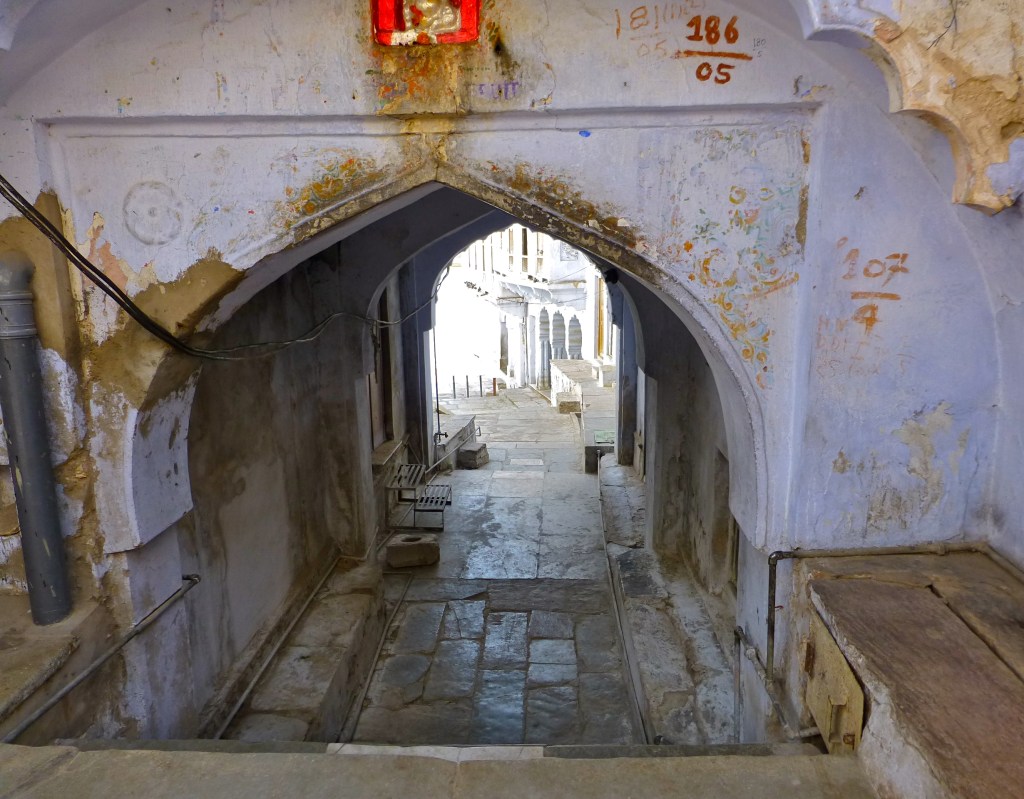
I was after Gau Ghat in particular, and hoped this would not be too problematic among so many, but I found it relatively easily. Venturing through an entrance that belied the ghat’s importance, I was surprised to find it virtually deserted. But that did not matter, I was not here for pilgrims. I found a suitable wall to lean against, munched on my samosa and surveyed the considerable views to my left and right, and across the lake.

Pushkar translates as “blue lotus” in Sanskrit, and one story tells of Lord Brahma (the Creator of the World in Hindu mythology), dropping his lotus flower on this spot, and thus creating the lake. As such, the waters are considered holy, washing away sin, as well as having medicinal and curative properties. At one time the lake was home to crocodiles, but apparently, someone in the time of the British Raj, thoughtfully caught them all, relocating them to a nearby reservoir. The wisdom and might of Queen Victoria was upheld, and the people and the pilgrims were henceforth able to pursue their religious observances and ritual immersions without fear.
Removing my shoes and stowing my camera in my bag so as not to offend, I walked down and stood at the top of the stairs of Gau Ghat, now also known as Gandhi Ghat. Here, the ashes of Mahatma Gandhi (among other notables), had been immersed, and the quietness here this day, gave me time to remember this great man. If I was ever asked who, in history, I would most wish to meet, Gandhi would head my list. I found it to be quite an emotional moment.

It was now time for my rendezvous with the camel and handler, who were taking me into the desert for the afternoon. They were patiently waiting; my camel gaily garbed in true Indian fashion, his handler sitting in the nearby shade. Formalities were taken care of and we were good to go. I was on, up and away!

Both camels and deserts always give me a sense of freedom and space so I always enjoy them. Besides, the view from atop a camel is way better than that of a horse. But, like a horse, it mainly comes down to the saddle, and this one was just fine. So I settled into the slow rhythm of the gait and took in the landscape as we made our way out into the desert . Passing by semi-permanent, shanty-styled dwelling camps just outside of town, I could not decide whether they belonged to the very poor, or they were fringe desert dwellers. Then they too were behind us, and it was just me, my camel and handler, making our way in silence through small rocky valleys and out into the vast emptiness of the wider plains beyond. There was nothing to see except the sky and the landscape. It was very still, and very quiet.

The afternoon sun was beating down and it was extremely hot, so, after a few hours I was more than happy to stop and take a break at a group of small, straggly trees. I walked a little to ease out some of the impending saddle-soreness, then rested, making use of the shade. Back in the saddle again and circling around a rocky mountain, we turned our direction back towards the town. As we got closer, I saw the odd person randomly walking through the middle of nowhere, but had become inured to that as it seemed to be a recurring phenomena of India, lacking any real explanation. Eventually we came to a small mountain with a temple on top. Through gestures and the odd single word, I realised I was being given the option of climbing up there to watch the sunset, or going somewhere else.

I knew this temple to be quite an important one, honouring another escapade of Lord Brahma and his consort, at the birth of Pushkar. Having said that, the temple was comparatively new, and there were nearly 700 steps to climb. Rather than slogging my way up those steps, I elected the “somewhere else”, so we turned and made our way back into the desert a little further. There, in the lengthening shadows, alone with my entourage, I watched the sun disappear behind a rocky mountain in a fiery, orange blaze. It was very, very peaceful!
The setting sun also meant it was time to wind up this day. It also bought a welcome release from the extreme heat as we turned and headed home.

Back in my hotel, I stepped out onto my little terrace to enjoy the evening view (a rather grubby pool in the foreground), over the lake and to the town beyond. This hotel was huge. Set on a wide swath of land, it was extremely impressive architecturally, reminding me of a Maharajah’s Palace. But I was the only guest! With it’s vast reception hall, elegant stately curved staircases, endless hallways that eerily echoed footsteps, the largest and heaviest room key ever, it had a full complement of staff, attending just me. It was very surreal! Additionally the staff, behind a guise of great friendliness, extreme politeness and effusive apologies, did not have a clue how to do anything! I actually entered their office to show them how to photocopy my passport when it became obvious I wasn’t going anywhere until it was done. The porter got lost showing me to my room! It went on! So it was with great amusement that I found one of them, sound asleep on the lawn, just outside my door. Perhaps she was exhausted after making up my room. I did not disturb her.

 truintraveltales.com