

My time in Monemvasia was a solitary experience. With the exception of a couple of taverna, all the businesses were closed because it was winter. It seemed I was the only person here; no other tourists, seemingly no townspeople. That part was not so surprising as there are only fifteen or so households actually living in the town. Maybe they were on holiday too. There were just a few early morning workers leading their donkeys along the street, laden with tools and materials, heading off to do whatever it was they were hoping to accomplish for the day, and not seen or heard again.
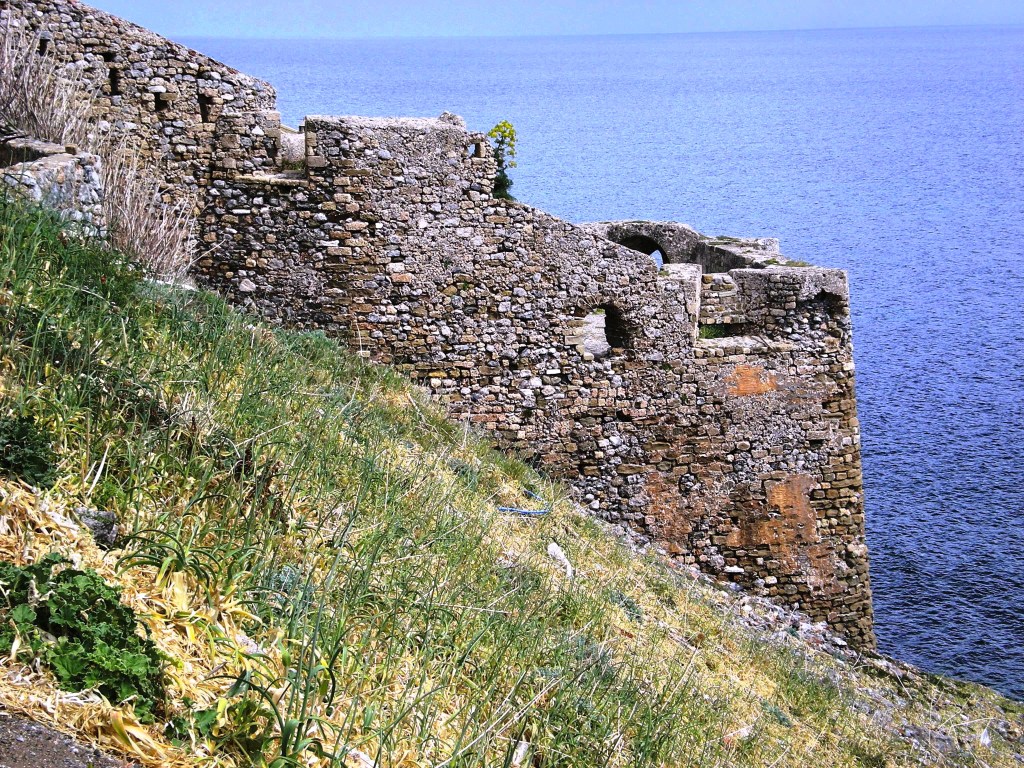
Even when I arrived at Monemvasia, this tiny island medieval town, two hundred metres off the Greek mainland, there was no sign of life. Just an empty car park at the base of a mighty rock soaring up out of the Myrtoan Sea. But walking towards the small, low cave, the “entrance”, I began to see the treats to come. Ancient tessellated battlements grew out of the rock above me and followed on down into the sea. Several gaily decorated donkeys, providing a small splash of colour against the rock and asphalt, stood, loaded down with bags of cement, sand and concreting tools, patiently awaiting their absent masters. Stopping for a brief chat and a pat, I stepped around them and entered the cave. A narrow passage, hewn out of the rock, emerged on the right, then shortly after turned hard left. Monemvasia, loosely translated, means “single passage” and it was immediately clear that I was entering a past, highly effective, defensible fortress.

Upon clearing the tunnel, I was instantly transported back to another time. Monemvasia is totally and authentically medieval. Stretched out in front of me was a narrow, cobbled street, lined with tavernas, the odd ‘converted’ hotel, and small shuttered up shops. All closed. Doorways were narrow and low, windows small and shuttered. There was no one around.
Because the causeway was not built until 1971, Monemvasia escaped the tourism-fueled modern hotel strips that so desecrated many of Greece’s jewels. It provided time for extremely stringent laws, governing building and restorations, to be legislated by archeological authorities, so there were no jarring notes of modernity intruding, at least on the exterior.

This isolated islet was separated from the mainland by an earthquake in 375. It was initially inhabited by the people of Laconia, who, fleeing the Slavic and Arab invaders of the time, took advantage of this natural fortress. However, there are references indicating the rock may have been used as a Minoan trading post in antiquity. By the 10th century, it was an important trade and maritime centre, as well as the main port for export of Malvasia, (the famous Malmsey wine) and a notorious haven for corsairs. Because of it’s strategic position and fortress-like qualities, over the centuries it has been besieged, sacked, sold and conquered by the Byzantines, Franks, Venetians and the Ottomans. By 1770, it’s commercial and strategic importance had severely declined, and the island was liberated back to Greece in their 1821 War of Independence.

I checked into my hotel, and then stepped out to explore. The main street opened out into a small square, flanked by a sixth century church on one side, and a mosque (now a museum) on the other. A small canon took centre place and it all overlooked the low battlements and the sea beyond. This day it was deserted and bare, and hard to imagine being filled with tables and chairs, people, sound and the colour of summer.
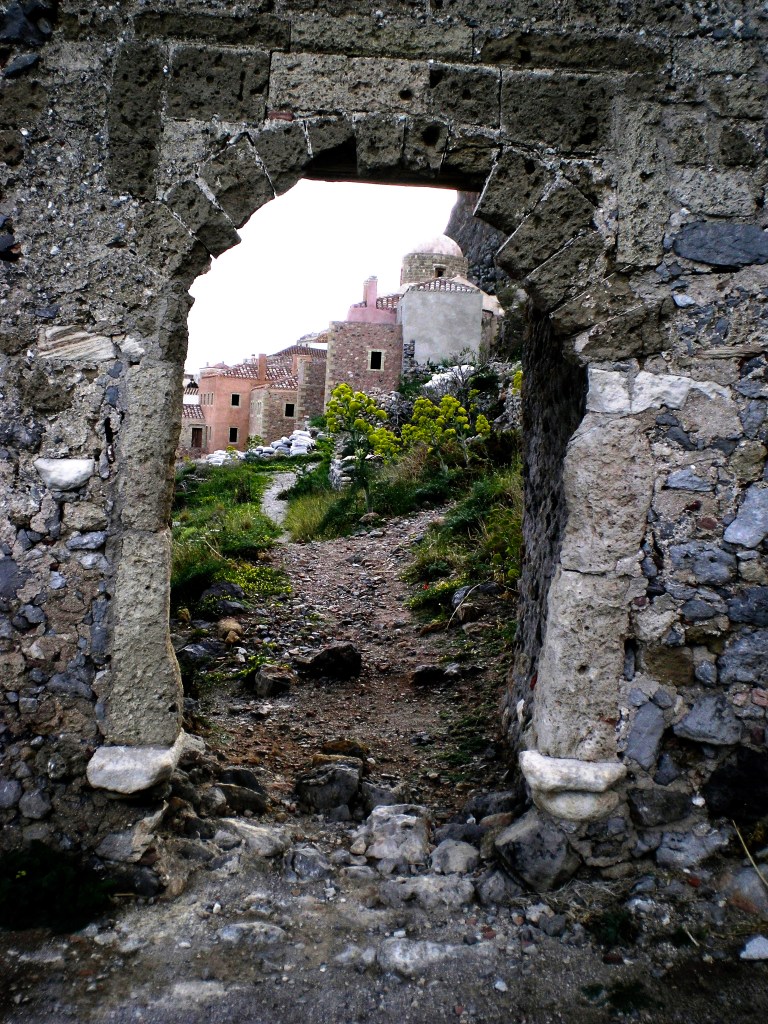
I walked along the top of the sea-wall battlements to the far end of the town. There I was met with an old stone watch-house and another set of battlements, also descending into the sea but much higher and longer than those at the entrance. There was a ruined arched opening in the wall, leading out into a small area of scrubby wasteland, happily occupied by grazing goats. Known as the Portello, this was the gateway to the wharves for traded goods in times gone past.
I turned and looked upwards. The town lay steeply above me, the stone and mud brick buildings tightly stacked, appearing to be almost built one on top of the other, as indeed some were. Land was limited and buildings had been erected on any available part of the rock. As they had been added on to, in whatever direction or manner feasible at the time, it gave an overall jumbled view. I found a set of steps and started to explore.
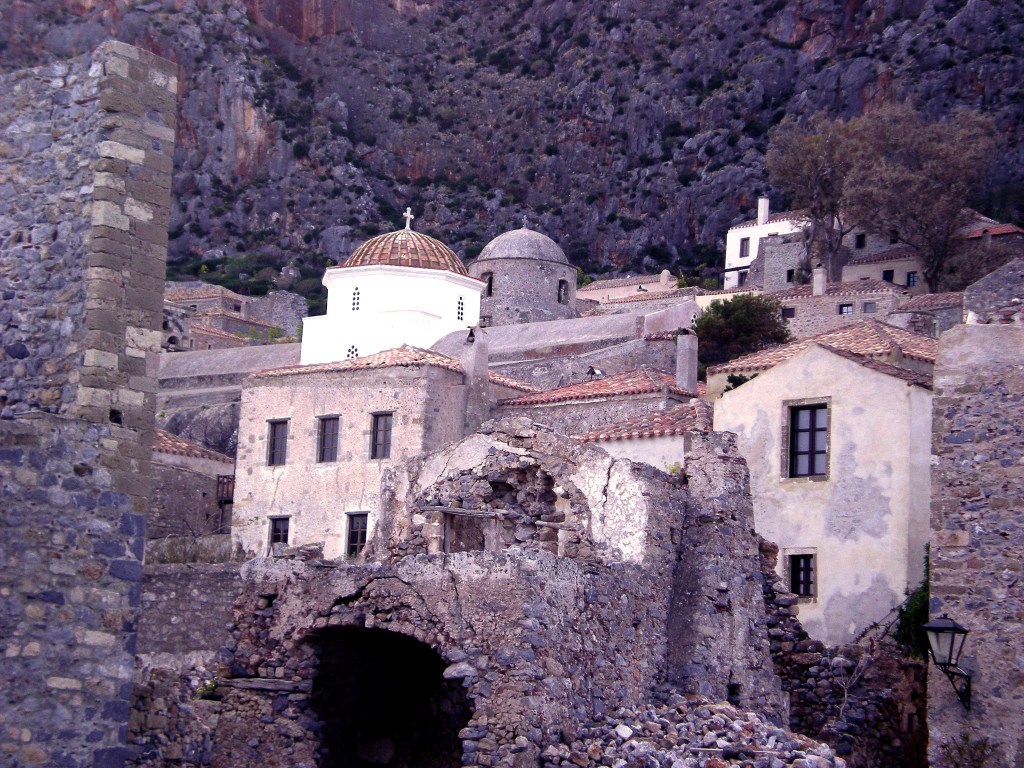

I let myself be happily lost as I threaded my way through a labyrinthine of alleys and paths, most only single file. Multi-level, stately mansions towered over me, some creating bridges to the opposite building. There were many and various sized churches, their heavily tiled domes topped with tiny iron crosses. Many of the buildings were very dilapidated and some just complete ruins, beyond restoration. There were high walls and low walls with bare Bougainvillea vines clinging to them, often spanning the lane, again giving hint of the picture it would become in summer. Here and there a group of potted plants indicated the entrance to a hotel or a taverna. I came across some residential homes, with tiny plots growing vegetables, a few plants splashing colour at their doorway, and the ever-needed washing-line. I said my “good-days” to the odd tethered goat and the occasional cat watched me impassively from some high perch. I did not meet a soul.

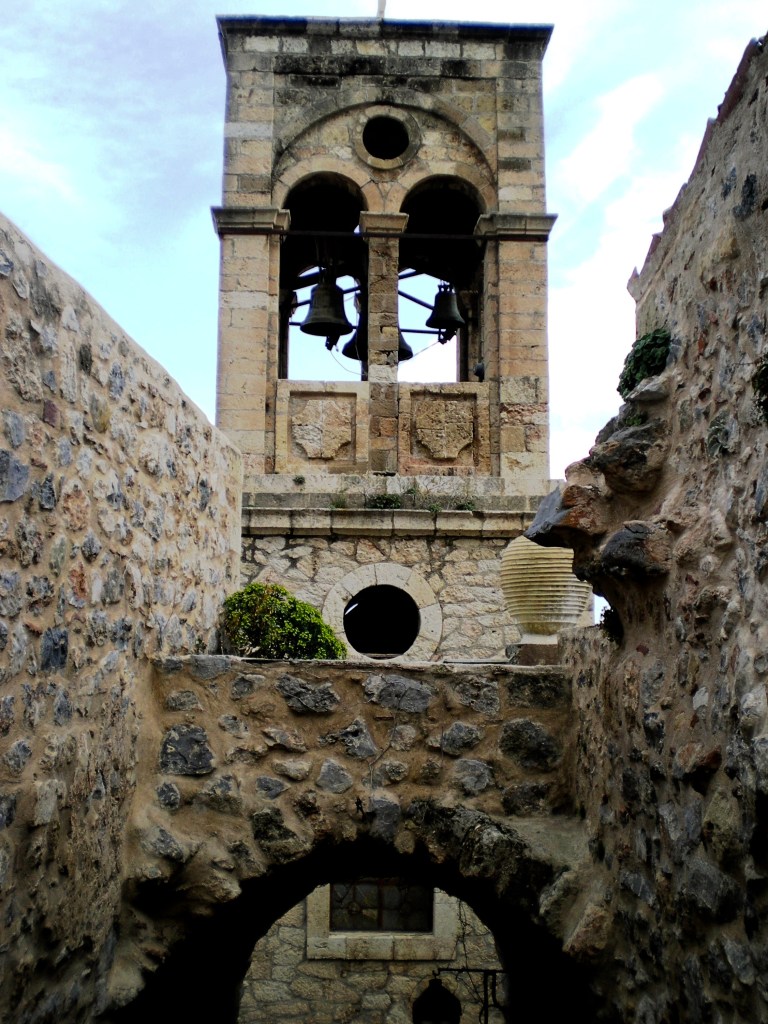

In the upper reaches of the town, the path would often open out to give a glorious view across the tiled rooftops to the sea below. Some even had a seat, or a rickety chair, inviting you to stop, relax and enjoy. Wildflowers were just starting to bloom, clinging to ancient walls, path edges, and among the rocks of the completely ruined sites.
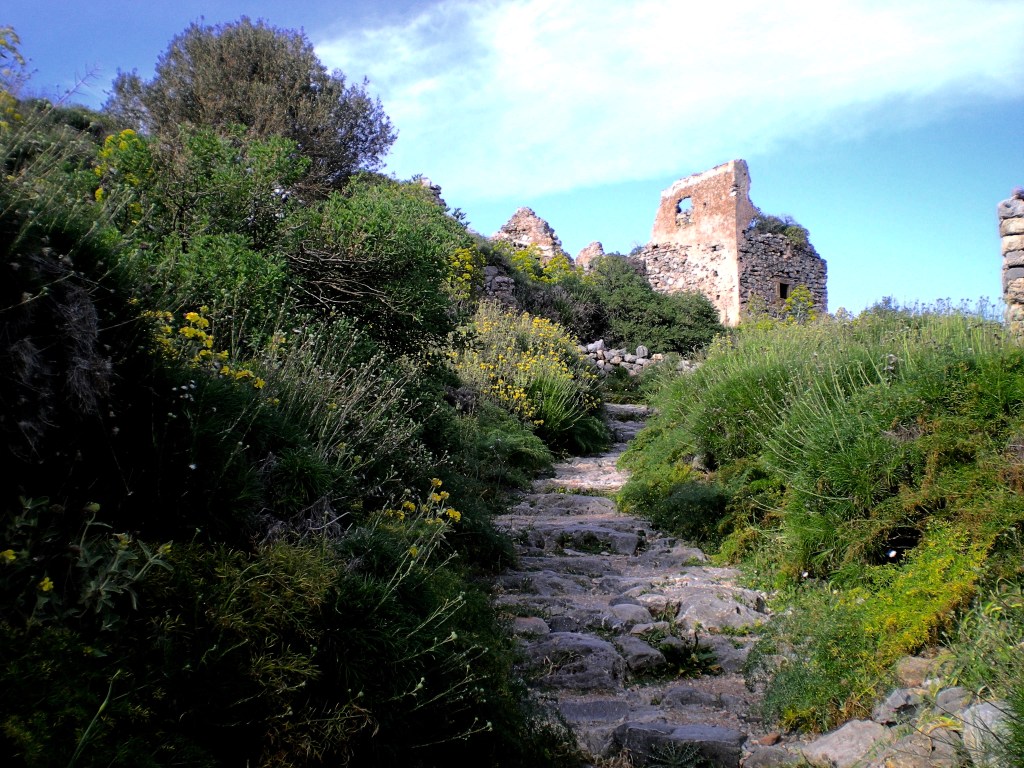

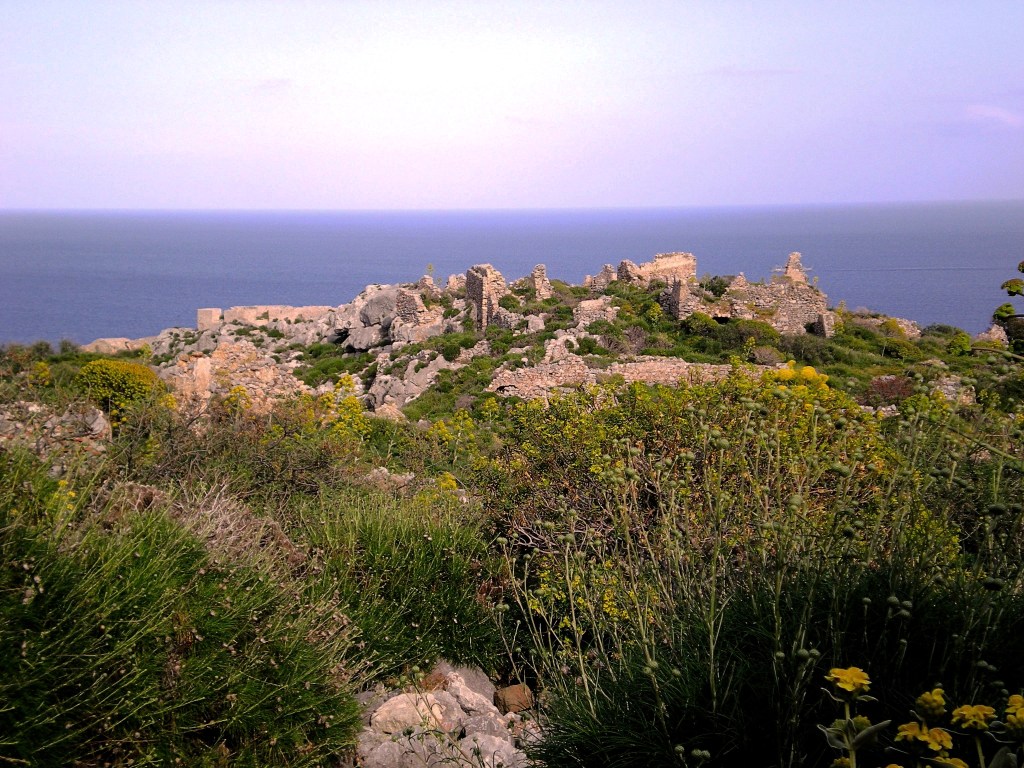
It was then time to explore the small plateau on the top of the rock, completely uninhabited, and known as Ano Poli. I zigzagged my way up the steep cobbled path (little more than a goat track), stopping on several occasions to drink in the view over the town below. This was the site of the original settlement, and in it’s heyday was filled with the mansions of the rich. Today all that remained was straggly grass and wildflowers, a few gnarled olive trees, the odd trace of long ago ruins, and the splendid, still-standing, 12th century Aghio Sophia Church. Unfortunately, this was fenced off with signs promising upcoming restoration, certainly warranted, but barred any closer inspection. So I picked my way around the top of the rock, enjoying the stunning views up and down the coast, and beyond, and just enjoying the peace and solitude. But most beguiling to me was sitting on the edge of the clifftop, just looking down into the beautiful deep aquamarine water, lapping gently on the rocks over 100 metres below.

Making my way back down to my hotel, I reflected on the fact that, for whatever reason, I had more or less had this ancient fortress town to myself for this past 24 hours. The winter season had stripped the life, colour and frivolity from the town, and had laid bare its bones. So much rock, both natural and man-made, had created an overall sense of bleakness, but it was not unfriendly, it gave a sense of impermeable simplicity. My aimless and solitary ramblings in the watery, winter sun, had given me time to absorb the setting, the history, the architecture and the atmosphere. The absence of people and the silence of the town removed the distractions. It left me free to hear the ghosts of the past, whispering to me of people and events, great and small, and of ways of life in times of long ago. This was a gift, and added so much extra charm and endurance to the memories of my time, in the medieval treasure that is Monemvasia.


 truintraveltales.com